
| United States Army Air Corps |
| Before becoming United States military pilots, fledgling Army aviators underwent the arduous task of attending and completing Air Corps cadet training. Aviation training consisted of several blocks of training from basic flight instruction to advanced flight school. The task of making it successfully through flight school was no easy task and many would-be recruits found themselves washed out of the training programs and on their way to carrying a rifle as part of an infantry unit, or off to learn another trade as part of an aircrew. Below are a number of Army Air Corp. cadet items in my collection. As indicated above, all of these items are original, WWII or in some cases pre-WWII items. |


| Above, left to right: A wartime cadet visor cap and a light blue, pre-war Air Corps cadet cap with a royal blue band and Air Corps Cadet device. |


| Above: Two original wartime photographs of the same Army Air Corps cadet. The cadet is unidentified. The PT-19A in the photos is identified as aircraft # 42-33691, which is known to have operated out of Thompson-Robbins Field, Arkansas during the war. |


| Two wartime photographs of the same Army Air Corps cadet, identified on one of the photographs as Del Morrison, with the photos both dated 1942. |
Pre-War and Training Items: Army Air Corps Cadet
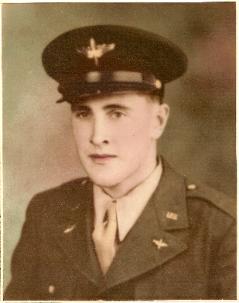

| Above: A rare, wartime color photograph of an Army Air Corps cadet. |


| A squadron dance for the 327th School Squadron, Basic Flying School was held on January 16, 1942. This is most likely related to Minter Field, one of the largest Army Air Corps training fields ever established, which was located in Bakersfield, California. The invitation came in its original envelope. For more information about Minter Field, see their website at: www.minterairfieldmuseum.com. |

The C.E. Daniel Collection


| Sustineo Alas: Sustain the Wings The distinctive insignia (DI) of the United States Army Air Force Technical Training Command, the Sustineo Alas pin displays a golden urn on a background of blue, holding three feather plumes and the words "Sustineo Alas" across the bottom on a golden background. Each of the three plumes represents each of the components of the United States Army Air Corps: the plane, the aircrew and the ground crew. Approved for wear on July 24, 1942, these DI were worn to denote assignment to the Army Air Corps Training Command, and would later be replaced upon reassignment. The modern interpretation is "Keep them flying." |
| Four different examples of the wartime Sustineo Alas pin. Seen is the difference between the various makers of the same basic insignia. The pin on the far right is a plastic version of the more commonly found all metal examples. |


| Some hot-shot wing over wing flying in an AT-6! |
| CPTP and the War Training Service Civilian Flight Instructors in WWII |
| Prior to 1940, the United States Army had approximately 4,500 pilots, including just over 2,000 who were active-duty officers, just over 2,100 reserve officers and a little over 300 who were national guard officers. As war seemed more likely, the number of needed pilots grew rapidly from 982 in 1939, to approximately 8,000 in 1940, to over 27,000 in 1941. Still, with these record numbers, more pilots were still needed. At the time, the United States Army could not sufficiently handle the training of the large number of flying cadets required. The U.S. Army Air Forces relied on additional pilots from the CPTP (Civilian Pilot Training Program) and a large network of civilian flight schools under contract to the US Air Corps, as well as conducting training in its own schools. The CPTP (often shortened to CPT) would eventually operate at more than 1,100 colleges and universities, with over 1,400 individual flight schools. As a result of the high level of training provided by the CPTP, CPTP-trained pilots did well while receiving additional training at US Air Corps flight schools. Between 1939 and 1945, the CPTP would go on to train more than 435,000 pilots, logging over 12 million flight hours! Following the attack on Pearl Harbor, the CPTP became known as the War Training Service or WTS. From 1942 until the summer of 1944, WTS trainees attended college courses and took private flight training, signing agreements to enter into military service after their graduation. Graduates of the CPTP/WTS program entered into the US Army Air Corps Enlisted Reserve. Most graduates continued their flight training and commissioned as combat pilots. Still others became service pilots, liaison pilots, ferry pilots and glider pilots, instructors, or commercial pilots in the Air Transport Command. As the defeat of the Axis powers seemed imminent, and as it became clear that fewer pilots would be required in the future, the US military services ended their agreement with the CPTP/WTS in early 1944. The program was concluded in 1946. The CPTP and WTS provided a much needed service to the US Air Corps both before and during WWII. The CPTP/WTS provided the US Air Corps with civilian pilots who could easily transition to military pilot training, thus speeding up the process of getting qualified military pilots into aircraft of all kinds and off to the front. |


| Three views of a CAA/War Training Service visor cap, with original cap badge insignia. The visor cap is shown with a CAATC headset. Both the visor cap and the headset came together from the estate of a man who served as a civilian flight instructor during WWII. |


| A pink, Army Air Corps overseas cap with its original CAA/War Training Service insignia. This particular cap was once worn and owned by Hermann Kropp of Stroudsberg, Pennsylvania. If anyone has any additional information concerning Mr. Kropp, I would enjoy hearing from you. |


| Above: Three Department of Commerce, CPT Pilot Rating Books issued to James Berton Rudolph, and Mr. Rudolph's original pair of Enlisted Reserve CPT wings. As was occassionally practiced among CPT graduates, the "CPT" on the shield of the wings has been ground down to denote graduation from the program. Mr. Rudolph attended his CPT/WTS training at Muscatine Jr. College, with the log books showing his participation in "Elementary Army", "Army Secondary" and "Elementary Cross Country." The log books cover a time period from November of 1942 to January of 1944. The log books are well filled out and contain terrific details about the training Mr. Rudolph received. The log books indicate Mr. Rudolph did the majority of his training in Taylorcraft and WACO UPF bi-planes. Both were staples in the CPT/WTS program. |


| Civilian Flight Instructor cap device. |

| At an unknown airfield, civilian flight instructors stand-by awaiting assignments to trainees who are themselves hoping to become military aviators. |

| A wartime, 8x10 photograph showing a civilian instructor with five aviation cadets. The cadet on the lower left signed his name as "Douglas E. Caldwell, Seffner, Florida." The cadet in the upper left signed his name as "Bill Chandler, Tulsa, Okla." The instructor also signed the photograph as "John L. Fisher, Salisbury, Conn." |

| A wartime, 8x10 photograph showing three graduating classes from the Spartan Technical Training School in Tulsa, Oklahoma in 1943. If anyone from this graduating class comes across this page or if you have any information about this photograph, I would enjoy hearing from you. |


| A very common sight to many Army Air Corps cadets, a PT-17 instrument panel. When I first obtained this panel it was void of any instruments. I used only original, wartime era instruments to bring this instrument panel back to its original configuration. |

| An original wartime pair of Susineo Alas DI';s, still in their original Gemsco box. |


| The wartime tunic of a civilian flight instructor in the employ of the United States Army Air Corps. Displayed appropriately on the right cuff is the gold embroidered wings of a civilian flight instructor. |


| Two photographs showing civilian flight instructors serving at Victory Field, Vernon, Texas during the war. The instructor on the right has been identified as E. T. Belton, while the pilot on the left was identified as L. M. Rushinf. |

| webmaster@danielsww2.com |
 |


| To see a grouping in my collection related to another civilian flight instructor, click on the photo above and visit the page for Clarence S. Page Jr. |

| Left: An "elementary course" CPT Pilot Rating Book fissued to Francis Lee McLean. The log book is dated February 19th, 1943, and shows McLean attending flight training at Nebraska State Teachers College, with Clinch Flying Service as the contractor providing the instruction. Little is known about McLean's military service, which I am still researching. I do know that he entered into the United States Navy Reserve as a pilot, losing his life on April 19th, 1945 having earned the Air Medal. McLean is buried in the Manila American Cemetary in the Philippines, Plot H, Row 6, Grave 112. As additional information about his military aviation career comes to light, I will update this section of the webpage. |

| Left: Six CPT flight log books and a Pilot Information file from the military service of Carlton Alfred Smith of Mansfield, Ohio. Born on January 15, 1921, in Mansfield, Smith would become a pilot in the late 1930's and later found himself in the role of flight instructor for the United States Army Air Corps during WWII. Smith would maintain his love of flying throughout his life, later serving a long career with the Mansfield Fire Department. Mr. Smith passed away in March of 2011, at the age of 90. Smith's log books show that he attended the majority of his training at Harrington Air Service Inc. in Mansfield, Ohio. The log books cover a period from December of 1941 into late 1943, and show that Smith was part of both the Civilian Pilot Training Program and the War Training Service. The Harrington Air Service trained 1,500 pilots for military service during WWII. |

| Above/Left: An original era United States Army Air Corps cadet jacket, complete with Air Corps cadet insignia/patch, appropriately applied to the right sleeve. The close-up of the cadet insignia above shows the method of attachment to the jacket. |


Above: Combat Crew 291-54 while training in Topeka, Kansas, January 8,
1945. This is the Loveall crew, with the members identified on the reverse of the
photograph as: Glenn R. Loveall (Pilot), Albert Amerian (Co-Pilot), Frank Weible
(Navigator), Gay Waldroup (Bombardier), Wayne Barnes (Upper Gunner), Ralph
A. Simna (Radio Operator), John Paradise (Tail Gunner), John E. Burgin The
crewman with the patch on his eye was identified as John Paradise. Glenn
Loveall is on the far left, in the front row.
Mr. Loveall would go on to fly 15 combat missions, surviving the war and
making the Air Force his career. Loveall flew both the B-17 and the B-24 during
the war, and would later fly the B-36 Peacemaker.
1945. This is the Loveall crew, with the members identified on the reverse of the
photograph as: Glenn R. Loveall (Pilot), Albert Amerian (Co-Pilot), Frank Weible
(Navigator), Gay Waldroup (Bombardier), Wayne Barnes (Upper Gunner), Ralph
A. Simna (Radio Operator), John Paradise (Tail Gunner), John E. Burgin The
crewman with the patch on his eye was identified as John Paradise. Glenn
Loveall is on the far left, in the front row.
Mr. Loveall would go on to fly 15 combat missions, surviving the war and
making the Air Force his career. Loveall flew both the B-17 and the B-24 during
the war, and would later fly the B-36 Peacemaker.

| An overseas cap from the Glenn Shoop grouping, showing the appropiately applied early CPT patch. Shoop attended CPT training at the Univrsity of Oklahoma. To see additional items related to Mr. Shoop, please click HERE. |

| As evident by the insignia on his cap, a civilian flight instructor and four of his students pose in front of their PT-19. |


| Above: The wing at the left is the example that once belonged to James Berton Rudolph. The wing at the right is another original CPT wing, uncleaned and just as I obtained it. The difference can clearly be seen between the example with the "CPT" rubbed off and the bottom example of an issue wing. |

| Above: A wartime era private photograph of four Army Air Corps aviation cadets. The man standing to the far left is Robert M. Barkey. Mr. Barkey would eventually go into combat with the 325th Checkertail Clan. He would fly a total of 53 combat missions in both the P-47 (45 missions) and the P-51 (8 missions), logging over 200 hours of combat flying time. For his efforts, he was awarded the Distinguished Flying Cross, the Air Medal, with 12 Oak Leaf clusters, three battle stars and a Presidential Unit Citation. Mr. Barkey was credited with downing 5 Me-109s and was credited with a probable, a Macchi 202. I had the pleasure of meeting Mr. Barkey on many occasions as he was a terrific gentleman, always smiling, happy to talk airplanes and generous with his time. He was a true gentleman and a hero. |


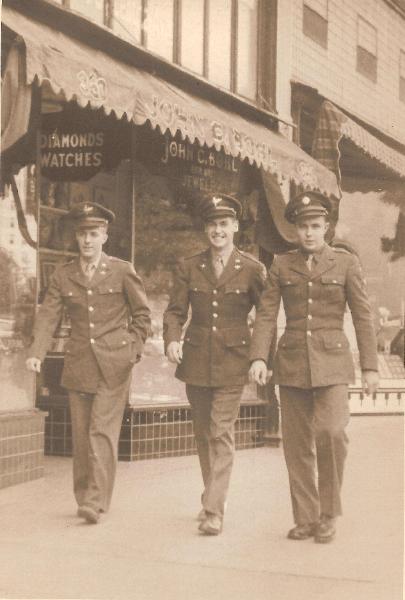
| Above and right: Photographs of Air Corps Cadets having fun in Hot Springs, Arkansas. In the photo to the right, the cadets are identified as (L to R): Dick (no last name), Blaine Madden and Jim (unknown last name). In the photograph above the man on the mule is identified as Melvin Meyers, Blaine Madden is sitting on the left in the cart, and the male on the right is identified only as "me." The photograph to the right is dated December 24, 1943. The photograph above is dated January 1944, and was taken in Hot Springs, Arkansas, in front of the John C. Bohl Jewelry store. Both Dick and Blaine can be seen wearing the same type of cadet jacket as shown above, with the Air Corps cadet patch on the right lower arm, just visible in the photos. |

| Left: An Army Air Corps/Force cadet sidecap with correct cadet insignia, displayed along with a pair of WWII era headphones. |


| particular propeller, model C 707, Serial Number 32843 was primary used on the Cessna T-50/UC-78, commonly called the "Bamboo bomber." The Bamboo bomber was used for training at Yuma Army Air Field for several years during WWII. The original wartime Yuma Army Air Field decals still covers the center section of the propeller. |